A microfibre cloth that pushes water around instead of picking it up, or that leaves a fine smear on glass it used to clean perfectly, has almost never worn out. It has been coated. Three things do the coating, and all three happen in the laundry: fabric softener, which deposits a deliberately water-repellent film; detergent and hard-water residue, which packs the spaces the cloth works by; and dryer heat, which glazes filament tips that are finer than anything else in your wash. The cloth looks identical afterwards. That is the whole problem — the failure is invisible, so it gets blamed on the cloth being cheap.
The rules that prevent it are printed by the manufacturers and are unusually consistent: wash microfibre on its own, use a liquid detergent for coloureds, never fabric softener, no bleach and no optical brighteners, keep to the temperature on the label, and dry on low heat or not at all. One maker goes further and publishes a number nobody else does — a maximum detergent pH. This article explains what those instructions are protecting, where they come from, and how to tell whether a cloth is recoverable or finished. Home Clean Manual has not laundered these cloths under controlled conditions and makes no claim to have done so; what follows rests on manufacturer product documentation, a granted patent specification describing how the textile is built, and published water-hardness standards, all cited so you can check them yourself. There is more on how to judge cleaning textiles as technical products on the Gear hub.
Microfibre does not absorb water. That single fact explains everything else
The intuitive model — a cloth is a sponge, it soaks water into its fibres — is wrong for microfibre, and every laundry rule follows from how wrong it is.
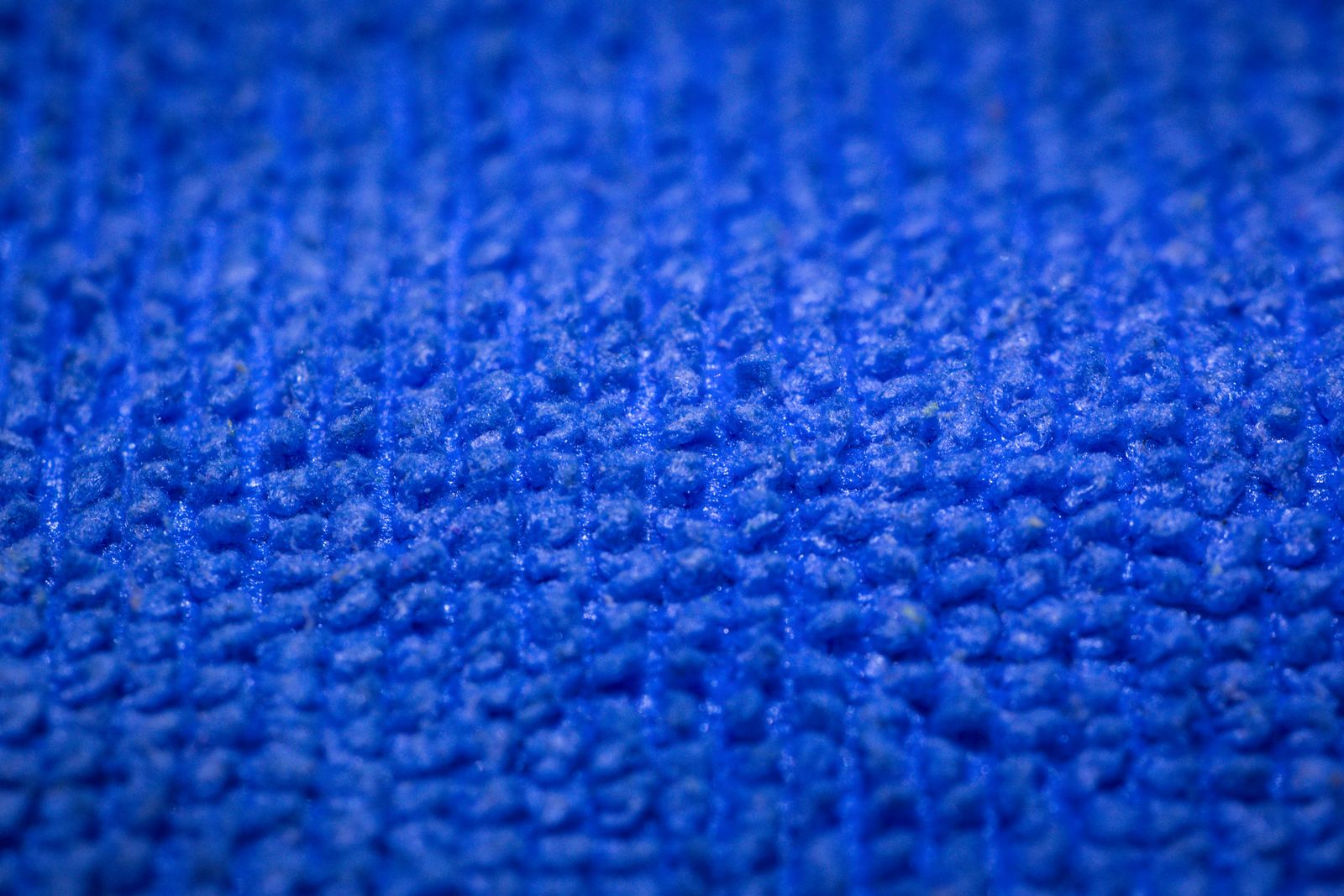
Cleaning-grade microfibre is a bicomponent filament: polyester and polyamide extruded together in a wedge or pie-slice cross-section, then split apart mechanically or chemically so that one thick filament becomes many very fine ones. Vileda Professional’s own technical page on microfibre puts the fineness at less than 1 dtex — decitex, the mass in grams of 10,000 metres of the filament — and describes the result as roughly one hundredth the diameter of a human hair. The same page distinguishes classic microfibre, split sixteen times, from its MicronFibre construction, split thirty-two times, and explains the division of labour between the two polymers: the polyester component attracts water while the polyamide repels it, which is what allows the cloth to lift and hold soil in water without leaving the drying marks a wetter, simpler textile would.
A German patent specification for a microfibre wipe cloth, DE 102 26 937 A1 (published 8 January 2004), sets out the same thresholds in the flat language of a technical document: microfibre is defined as fibre with a fineness below 1.0 dtex, with material below 0.3 dtex classed as ultra-microfibre; the preferred cloth has a basis weight of at least 120 g/m², optimally 150–200 g/m². And it states the point that reframes the whole subject: microfibre itself cannot absorb water. What the cloth does is hold water in the enormous interstitial space — the air chambers and fine pores — created by packing very fine filaments together, drawing it in by capillary action. Greenspeed’s product page for its Original microfibre cloth quantifies the effect from the other end: “high absorbency, 6 times its own weight.”
So the working part of a microfibre cloth is not the fibre. It is the gaps, and the sheer number of filament edges presented to the surface. Both are microscopic and both are open. Fill them, coat them, or fuse them and you have a cloth that weighs the same, feels similar and no longer works. That is the mechanism behind every instruction below, and it is why “buy better cloths” is usually the wrong answer to a cloth that has stopped performing.
Fabric softener is the single most documented mistake
Manufacturers do not usually agree about anything. They agree about this, and they put it in short imperative sentences.
Kärcher’s microfibre floor cloth set for the EasyFix nozzle — order number 2.863-259.0 — carries the whole care instruction in two clauses on its product page: “Maschinenwäsche bis 60 °C möglich. Keinen Weichspüler verwenden.” Machine washable up to 60 °C; use no fabric softener. SharkNinja’s care guidance for Shark steam mop Dirt Grip pads says the same thing and, unusually, gives the reason: avoid bleach, powdered detergent and fabric softeners, because these “may damage or leave a coating on the Dirt Grip pads that will reduce their cleaning performance and absorbency”. Greenspeed’s care instructions for its Original cloth arrive at the same place from the detergent side, ruling out products containing bleach or optical brighteners.
The chemistry is not mysterious. Fabric softeners are built on cationic surfactants — molecules with a positively charged head that binds to the slightly negative surface of laundered fibre, leaving a fatty tail pointing outwards. That outward-facing fatty layer is the product working exactly as designed: it lubricates fibres so cotton feels soft and does not build static. It is also, functionally, a thin water-repellent film. Applying a deliberate hydrophobic coating to a textile whose entire operating principle is capillary uptake into open microscopic space is a direct contradiction, and the cloth loses on both counts — the film repels water and the softener residue occupies the gaps that were supposed to hold it.
Three practical consequences follow, and the second and third catch people who have already stopped using softener:
- Dryer sheets do the same job by another route. They exist to transfer softening agents onto fabric using dryer heat. A cloth washed correctly and then tumbled with a dryer sheet has been softened.
- A softener dispenser that has been used for years holds residue. If the machine’s dispenser drawer and siphon are coated, a rinse cycle can still deliver some of it. Cleaning the dispenser is part of a general machine service — the same job covered in how to clean a washing machine.
- “2-in-1” and “with conditioner” detergents contain softening agents by design. Read the front of the bottle before you conclude you have stopped using softener.
Detergent: the pH ceiling nobody quotes
Every article on this subject says “use a mild detergent”. One manufacturer publishes an actual limit, and it is the most useful single number in this whole topic.
Greenspeed’s care instructions for its Original microfibre cloth specify washing at 60 °C with a detergent for coloured fabrics, and then set out constraints: do not use washing powder — use a liquid detergent; do not use detergents containing bleach or optical brighteners; and do not use detergents with a pH higher than 10. The same page tells you to rinse cloths before washing to remove residual cleaning chemicals, and to wash microfibre separately from other fabrics where possible. It also claims the cloth is “washable at least 600 times”.
Each of those constraints is protecting something specific:
- The pH ceiling of 10 is the one to write down, because it quietly invalidates a large amount of popular internet advice. The standard folk remedy for “dead” microfibre is to boil it in a solution of washing soda (sodium carbonate) or to add soda to the wash. A working solution of sodium carbonate sits above pH 11. Polyamide — the half of the split pair that does much of the soil-trapping — is the more chemically sensitive component of the two, and strongly alkaline conditions at temperature are not kind to it. A manufacturer that publishes a numeric limit is telling you where its warranty of performance ends, and the folk remedy is comfortably outside it.
- Liquid rather than powder is about undissolved solids. Powder detergents carry insoluble or slowly-soluble builders and fillers; a textile whose working structure is a dense mat of sub-micron gaps is an efficient filter for exactly that kind of particle. Shark’s pad guidance names powdered detergent alongside bleach and softener for the same reason.
- No optical brighteners is more elegant than it sounds. Optical brightening agents are fluorescent dyes whose entire function is to deposit on the fibre and stay there, converting ultraviolet light into visible blue so fabric reads as whiter. They are, by definition, a coating you are paying to apply. On a colour-coded cleaning cloth they achieve nothing and add residue.
- No chlorine bleach. Both Greenspeed and Shark exclude it. Beyond the polyamide question, bleach destroys the colour coding that the cloths exist to carry — and colour coding is a hygiene control, not decoration.
- Rinse before washing. Cloths come out of service loaded with whatever chemistry you were cleaning with. Putting an alkaline degreaser into a wash alongside a pH-limited detergent means you no longer know what pH the cloth is sitting in.
Temperature: follow the label, not the internet
The numbers that manufacturers publish for their own products are lower and narrower than the advice you will read elsewhere. Kärcher’s floor cloth set: machine wash up to 60 °C. Greenspeed’s Original cloth: 60 °C with a colour-safe liquid detergent. Shark’s pads: warm water with liquid detergent.
Professional cleaning textiles rated for higher temperatures do exist, and the reason they exist is disinfection rather than cleaning performance — a laundry process for a healthcare setting has to kill organisms, not just remove soil. If the label on your cloth carries a higher figure, that figure is the one to follow. What you should not do is assume that hotter is generically better. Repeated high-temperature washing accelerates the loss of the split-filament structure that does the work, and the durability figures manufacturers publish are tied to a specific process, not to any process.
Which brings us to the most quietly revealing sentence found anywhere in this research. Vileda Professional’s page for the MicroTuff Base cloth does not simply claim a durability number — it states the test conditions: “High durability up to 300 washes, tested at internal lab at 60°C chemical thermal disinfection.”
Read that carefully. The figure is (a) an internal laboratory result, not an independent one; (b) measured under chemo-thermal disinfection — a laundry process that uses a disinfectant chemical at a moderate temperature instead of relying on heat alone; and (c) specific to 60 °C. It is a perfectly honest disclosure, and it is far more informative than the bare numbers most brands print. But it also means that Vileda’s “up to 300 washes” and Greenspeed’s “at least 600 times” are not comparable quantities. They are two internal claims measured against two undisclosed protocols, and no page — this one included — can tell you which cloth lasts longer, because the test methods are not published. Anyone who tells you otherwise is guessing.
Drying is where cloths die fastest
Both of the makers whose full care text was available push you away from the tumble dryer rather than merely capping its temperature. Greenspeed: avoid mechanical drying as much as possible, to extend the product’s life. Shark: dry Dirt Grip pads on low heat, or line dry.
The reason is a matter of surface area and mass. Polyester and polyamide are thermoplastics — they soften before they melt. A filament under 1 dtex has an extraordinary ratio of surface to mass, so it reaches the dryer’s air temperature almost instantly and has essentially no thermal inertia to protect it. At the tips of a split filament, where the material is finest, softening is enough to round over and fuse neighbouring filaments together. That reduces the edge count that does the cleaning and closes the capillary gaps that do the absorbing. A heat-glazed cloth has a characteristic feel: slick and slightly plasticky rather than grabby, and it skates across glass instead of biting.
Two more drying rules follow from the same physics. Never iron microfibre — an iron plate is far above the softening range and will glaze a cloth in one pass. And separate microfibre from cotton in both the wash and the dryer, which manufacturers put in terms of cross-contamination and lint: cotton sheds prodigiously, microfibre is a superb filter, and a cloth loaded with cotton lint smears. If you have ever washed microfibre with towels and then found it leaves fluff on a mirror, that is not a defect in the cloth.
Hard water is doing half the damage, silently
There is a residue source that has nothing to do with what you put in the machine. Calcium and magnesium ions in hard water react with anionic surfactants in ordinary detergent to form insoluble calcium and magnesium salts — the classic “soap scum” — and those deposit in the textile during the wash. On a cotton towel you might notice slight stiffness. On a textile that works by keeping microscopic gaps open, it is a direct attack on the working structure.
As with steam appliances, the fix begins by replacing the adjective with a number. The US Geological Survey classifies water hardness, as calcium carbonate, at soft 0–60 mg/l, moderately hard 61–120, hard 121–180, and very hard above 180. Germany does it in statute: § 9 of the Wasch- und Reinigungsmittelgesetz defines Härtebereich weich as “weniger als 1,5 Millimol Calciumcarbonat je Liter”, mittel as 1.5 to 2.5 mmol/l, and hart as “mehr als 2,5 Millimol Calciumcarbonat je Liter”, and obliges water suppliers to tell customers which band applies “mindestens einmal jährlich” — at least once a year.
Two things are worth taking from the comparison. First, the bands do not line up: one millimole of calcium carbonate per litre is roughly 100 mg/l, so German law does not call water “hard” until about 250 mg/l, while the USGS calls anything above 180 mg/l very hard. A supply at 200 mg/l gets two different adjectives depending on which document you are reading. Second — and this is the part that matters for laundry — notice why German law imposes that disclosure duty at all. It exists so that consumers can dose detergent correctly, which is why German detergent packs print dosing tables by hardness band. Dosing to hardness is the mainstream, legally-supported practice in one of Europe’s largest markets and is almost unknown in English-language laundry advice.
The practical rule for cleaning textiles: find your figure, dose to it, and resist the instinct to add extra detergent because the cloths are dirty. Overdosing in soft water leaves surfactant residue in the fabric; under-dosing in hard water lets calcium soaps deposit. Both end in the same place — a cloth full of solids that used to be full of air.
Is this cloth recoverable, or finished?
There is a fast, non-destructive test that follows directly from the mechanism, and it costs nothing.
Take the cloth dry and put a single drop of water on it. On a healthy cloth the drop is gone on contact — the capillary structure pulls it in before it can form a bead. On a coated cloth the drop sits proud for a second or two, or spreads reluctantly. On a badly softened or glazed cloth it beads and can be rolled around the surface. That is a direct read on whether the capillary space is open, which is the only property that matters.
What the result tells you:
- Absorbs instantly, but smears on glass. The structure is intact; the contamination is on the surface. Usually lint from being washed with cotton, or greasy soil the last wash did not lift. Rewash alone, liquid detergent for coloureds, no softener, and add a rinse.
- Hesitates, then absorbs. Partial coating, typically softener residue or detergent overdosing. Wash again on its own at the label temperature with a reduced detergent dose and an extra rinse. Line dry. Several cycles may be needed, since you are washing residue out of a structure designed to hold things.
- Beads and stays beaded after two or three correct washes. The cloth is either heavily softened or heat-glazed. Glazing is not reversible — it is a physical change in the filament. Demote it to garage, boot-room or outdoor duty rather than trying to rescue it.
- Absorbs fine but feels thin and slick, and the edges are shedding. This is genuine wear. Retire it. Shark’s own guidance treats three to four months as normal service life for its steam mop pads under regular use, on the basis that “dirt particles, grease friction and repeated washing can cause the fibres to break down”. Pads and cloths are consumables with a service life, and pretending otherwise costs more in redone work than the replacements do.
Two popular rescue methods to think twice about. Boiling microfibre in a washing-soda solution exceeds the pH 10 ceiling Greenspeed publishes for its own cloths, and does so at temperature — the conditions polyamide likes least. Adding chlorine bleach to “strip” a cloth is excluded by both Greenspeed’s and Shark’s published instructions and destroys the colour coding. If a cloth beads after a proper rewash, the honest answer is that it is finished, not that it needs harsher chemistry.
Colour coding is a control system, and bleach destroys it
The colours are not there to look tidy. They exist to make cross-contamination visible to a supervisor from across a room, and they are one of the reasons professional cleaning textiles are bought in quantity rather than singly.
Vermop, the German professional cleaning-systems maker, publishes its scheme for surface cleaning cloths and their containers: blue for general surface cleaning, furniture and offices; green for surfaces in hospitals, operating theatres and kitchen areas; yellow for sanitary surfaces — bathroom, sink, tiles; and red for toilets and urinals. Vileda Professional supplies its MicroTuff Base cloth in the corresponding four colours: blue, red, yellow and green.
Two cautions. The scheme is a convention, not a universal standard — the blue/green pairing in particular varies between countries and between healthcare and food-sector guidance, so a cloth’s colour tells you what a specific organisation decided it means. And the scheme only works if the colours survive laundering, which is one more argument against bleach and optical brighteners. At home the useful version is simpler and still worth doing: one colour that never leaves the bathroom, one that never enters it. The reasoning behind keeping surfaces separated, and why a single cloth fails even within one room, is set out in the two-cloth method.
A wash routine that satisfies every instruction quoted here
Nothing in this list is invented. Each line traces to a manufacturer instruction cited in the sources below.
- Rinse cloths before they go in, to get residual cleaning chemistry out of the fabric (Greenspeed).
- Wash microfibre on its own — not with cotton towels, not with cleaning rags of other fibres (Greenspeed).
- Liquid detergent for coloureds, not powder, with no bleach and no optical brighteners, and nothing above pH 10 (Greenspeed; Shark also excludes powder and bleach).
- Dose to your water hardness, and do not add extra because the load looks dirty (USGS / § 9 WRMG bands for the number).
- No fabric softener, ever, and no dryer sheets (Kärcher; Shark).
- Wash at the label temperature — 60 °C is the figure Kärcher and Greenspeed publish for the products documented here (Kärcher; Greenspeed).
- Add a rinse if your machine allows it. You are trying to leave nothing behind.
- Line dry, or tumble on low. Avoid mechanical drying where you can, and never iron (Greenspeed; Shark).
- Store dry. A damp cloth folded in a caddy grows biofilm, which is the source of the smell people blame on the cloth being “old”.
Frequently asked questions
Can I wash microfibre with my towels to save a load?
No, and it is the most common self-inflicted wound in this topic. Greenspeed’s instruction is to wash microfibre products separately from other fabrics where possible. Cotton sheds lint continuously; microfibre is an efficient filter with an enormous internal surface. The cloth comes out loaded with fibre it will then deposit on the first pane of glass you touch. Separate them in the dryer too.
Do I need a special “microfibre detergent”?
Nothing in the manufacturer instructions gathered here requires a branded microfibre detergent. What they require is a set of properties: liquid rather than powder, formulated for coloureds, free of bleach and optical brighteners, and below pH 10. A plain liquid colour detergent generally satisfies all four. The specialist products are convenient, not obligatory.
Can I use vinegar to strip a cloth that has gone water-repellent?
An acid rinse addresses one specific failure — calcium and magnesium soaps deposited from hard water — because those deposits dissolve in acid. It does nothing about fabric-softener film, which is not a mineral, and nothing at all about heat glazing, which is a physical change. So it is a targeted tool for one cause rather than a general revival treatment. Check your cloth’s own care instructions first, keep it well away from anything containing bleach, and treat a cloth that still beads after a correct rewash as finished.
Why do my microfibre cloths smell even after washing?
Usually biofilm, in the cloth or in the machine. Cloths stored damp are an ideal substrate, and a washer run consistently at low temperatures with a softener-coated dispenser develops its own residue that reinfects every load. Dry cloths fully and openly between uses, wash at the label temperature rather than reflexively at 30 °C, and service the machine itself — the drawer, the door seal and the filter — as set out in how to clean a washing machine.
What does “300 washes” or “600 washes” on the packaging actually mean?
Less than it looks like. Vileda Professional’s MicroTuff Base page discloses its conditions — up to 300 washes, tested in an internal laboratory at 60 °C chemo-thermal disinfection — which is more transparency than most brands offer, and it also shows why the numbers cannot be compared. Greenspeed’s “at least 600 times” is measured against a protocol that is not published. Different temperatures, chemistries, load weights, spin speeds and end-point definitions produce wildly different counts. Treat these as durability claims made under the maker’s own conditions, not as a specification you can hold them to.
Is microfibre actually better than cotton, or is that marketing?
They fail differently, and the difference is structural rather than promotional. Cotton absorbs water into the fibre itself and holds it; split microfibre holds water in capillary space between filaments and presents a very large number of fine edges to the surface. That structure is what makes microfibre effective with little or no chemical and what makes it capable of leaving glass dry rather than merely wet. It is also what makes it fragile in the ways described above — a cotton cloth is largely indifferent to fabric softener, and a microfibre cloth is ruined by it. The advantage is real, and it is entirely conditional on the laundry.