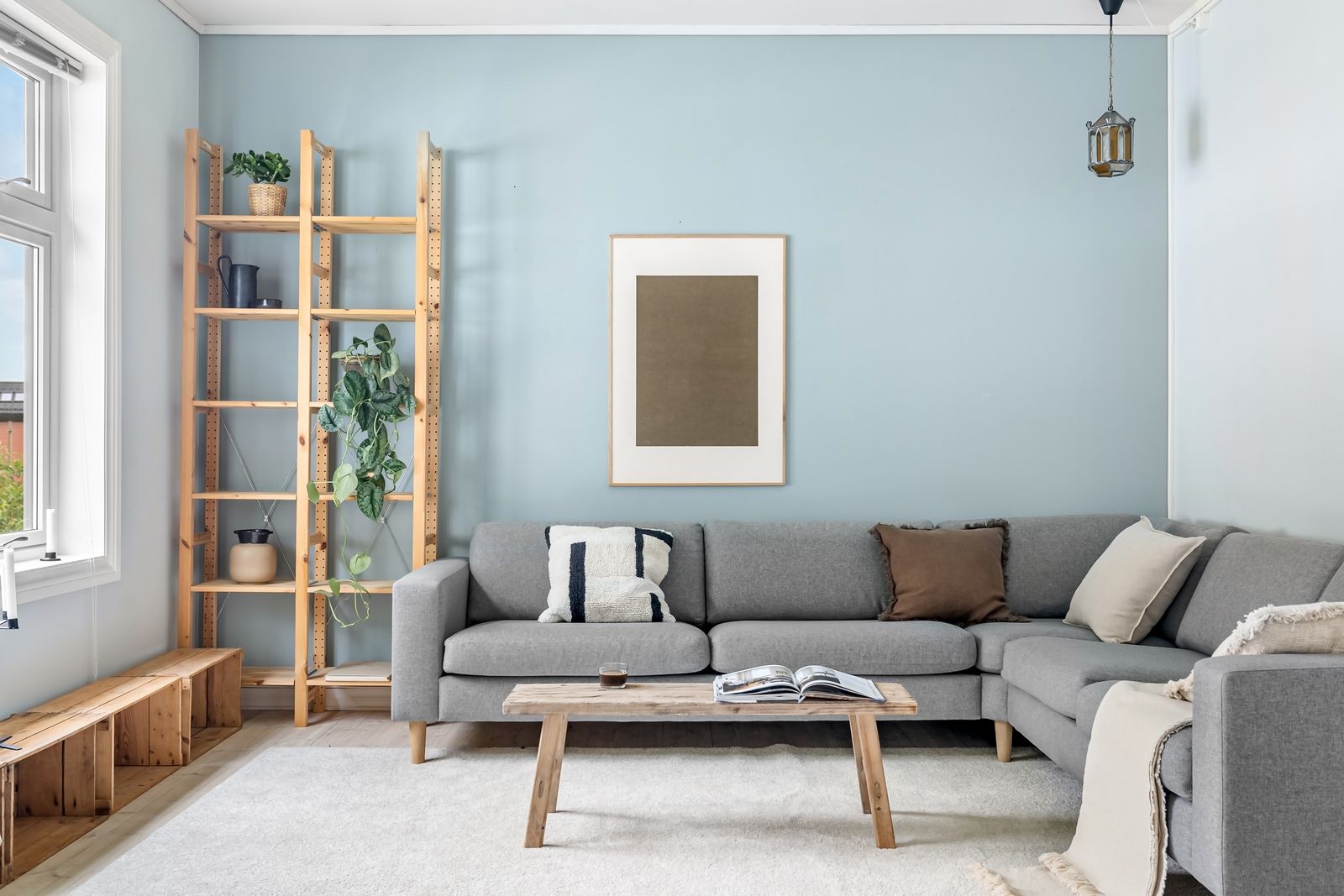
You have ninety minutes and people are coming. The mistake nearly everyone makes in that situation is to start cleaning, because cleaning is not what the next ninety minutes is for. Cleaning removes soil. What you actually need is a controlled appearance along a route you can predict, delivered inside a fixed deadline, with nothing half-finished when the doorbell goes. Those are different objectives and they produce a different order of work.
The commercial cleaning trade separates these two things formally and sells them as different services. German contractors distinguish Unterhaltsreinigung — scheduled maintenance cleaning, which treats visible and non-visible areas alike — from Sichtreinigung, defined in German trade explainers as a stripped-down form of cleaning in which only the visible areas of the floor and other sightline surfaces are dealt with. It is described as a service for daily need: after a meal, light soil in an entrance area, or before a client visit. That last one is your situation exactly. What follows is the ninety-minute version of it, built around published productivity figures rather than guesswork about what feels urgent.
The objective is not cleanliness, and pretending otherwise costs you the deadline
Everything that goes wrong in a pre-guest panic comes from one error: treating the ninety minutes as a small deep clean instead of as a separate category of work with its own success condition.
The success condition here is narrow and it is worth writing down before you touch anything. Nobody arriving at your house inspects it. They walk a path — door, hallway, the room they sit in, the bathroom, possibly the kitchen — they take in that path at eye level and at conversational distance, and they form an impression in the first two or three minutes that nothing later in the evening will meaningfully revise. Every minute you spend outside that path is a minute spent on work that will not be observed tonight. It may be work worth doing on Saturday. It is not work worth doing now.
This is not a trick or a cheat. It is the same reasoning the trade applies when it prices a Sichtreinigung as a different product from a maintenance clean. The scope is genuinely smaller, the buyer knows it is smaller, and the work is judged against a visible-surfaces standard rather than a hygiene standard. Where you get into trouble is buying the cheap product and then judging yourself against the expensive one — starting a job scoped for appearance and then, forty minutes in, deciding to properly do the oven.
So the first act of triage is not physical. Decide, before you move, that tonight’s standard is visible surfaces on the visitor path, finished, with nothing in pieces. Then defend that decision for ninety minutes against every impulse to upgrade it.
Where the ninety minutes actually goes
Most speed-cleaning advice never puts a number on anything, which is why it never survives contact with a real deadline. The commercial sector does put numbers on things, because contracts are priced from them, and the two most useful sets are worth understanding even though neither was written for houses.
ISSA — the international trade association whose workloading figures sit behind a large share of commercial cleaning bids — publishes standard cleaning times built, in its own description, from five components: task, tool, time, total units and training. Its published worked examples are specific enough to be useful here. Spot cleaning is costed at 3.62 minutes per 1,000 square feet. Single-task mopping with a 14-inch flat mop and a dual-chamber bucket is rated at 5,355 square feet per hour — about 11.2 minutes for the same 1,000 square feet. Restroom fixture cleaning is estimated at three minutes per fixture.
Look at the first two together, because the ratio is the entire argument for triage. Dealing with the visible marks on a floor area costs roughly a third of what wet-cleaning the whole of that same floor costs. Not a tenth — the difference is real but it is not infinite — but a factor of three is exactly the margin that turns “I cannot possibly get to all of it” into “I can get to all of the part that shows.” If you have floor area in three rooms and ninety minutes, the choice between spot-treating three floors and properly mopping one is not close.
The second set of figures comes from German facility-management practice, which publishes Leistungskennzahlen — performance figures in square metres per hour — broken down by room type. One German FM reference gives these ranges for maintenance cleaning:
| Room type | Published range (m²/hour) |
|---|---|
| Corridors and circulation | 300–1,200 |
| Offices | 200–700 |
| Meeting rooms | 160–240 |
| Sanitary rooms | 60–180 |
| Entrance areas | 60–160 |
Read that table as a map of where your ninety minutes will disappear. Circulation space is the cheapest square metre in the building — potentially twenty times cheaper per square metre than an entrance area. Bathrooms and entrances are the most expensive, and they are the most expensive by a wide margin, in a document written about offices where the entrance is a lobby with a mat and a door.
Your house has the same shape. The hallway is nearly free. The bathroom and the front door are where the minutes go. And those are precisely the two places a visitor stands still and looks around. That is an unusually convenient coincidence and the whole plan below is built on it.
One caveat that matters: ISSA is explicit that its cleaning times are an estimating guide rather than a time-and-motion study, and the German ranges are published as Richtwerte — reference values, deliberately wide. Nobody is claiming your hallway is 900 m²/h. The point is the relative cost of room types, and on that the two sources independently agree.
The visitor path is the only map
Before anything else, walk the route your guests will walk, from the outside of the front door to the chair they will sit in, and then the detour to the bathroom. Walk it slowly and at their height, not yours. Write down what you see. This takes about three minutes and it is the highest-value three minutes in the entire ninety, because it converts a vague sense of “the house is a mess” into a finite list.
Four things usually appear on that list that would not have appeared on a mental one:
- The approach and the threshold. The doormat, the step, the inside of the door, the first metre of floor. This is the first surface anyone touches and the one you have stopped seeing entirely.
- Eye-level horizontals in the hallway. The shelf or console by the door, the radiator top, the newel post. Guests stand still here while taking off coats, which is longer than they stand still anywhere else except the bathroom.
- The seat-height view. Sit in the chair a guest will sit in. Coffee-table surface, the underside edge of the table, the front of the sofa, whatever is at knee height on the far wall. This view is completely different from the standing view and nobody ever cleans it.
- The bathroom, in full. There is no partial credit available in a bathroom. It is the one room a guest is alone in, with nothing else to look at, for two to four minutes.
Everything not on the path gets one treatment and one only: the door gets closed. A closed door is not a failure of hospitality, it is scope control, and it is the single most effective time-saving decision available tonight.
If you are going to buy anything for this at all, buy the thing that lets you carry the whole job with you in one trip rather than the thing that cleans marginally better — a caddy or a tote that holds cloths, one spray and a bin bag, so that the path is walked once. The gear that makes a single-pass clean possible matters more under a deadline than the gear that makes any individual surface cleaner, because every unplanned return trip for a forgotten bottle costs you roughly what cleaning an entire extra bathroom fixture would have cost. That arithmetic is set out in more detail in what professional cleaners do differently, and it is the reason the trade standardises kit rather than choosing it per job.
What the standards say you are allowed to skip
The most useful permission in this entire article comes from a Nordic standard, and it is worth knowing about because it means skipping the hard-to-reach parts is not a compromise you invented under pressure — it is written into the way professional cleaning quality is formally assessed.
NS-INSTA 800-1:2018, published by Standard Norge as Rengjøringskvalitet — Del 1: System for å fastsette og bedømme rengjøringskvalitet (“Cleaning quality — Part 1: System for establishing and assessing cleaning quality”), is the Nordic system for specifying and inspecting cleaning quality. Two features of it are directly relevant tonight.
First, it assesses the result, not the work. Standard Norge’s own description states that the system is independent of cleaning method, of the system used, and of cleaning frequency. NHO Service og Handel, the Norwegian service-sector employers’ association, puts the same point more bluntly in its explainer: the standard says nothing about how the cleaning is to be carried out. It contains six quality levels, 0 to 5, where 5 is the highest and 1 the lowest, and level 0 has no practical significance. What you get judged on is what a person can see afterwards. Not the hours, not the method, not whether you used the correct cloth for the correct surface.
Second — and this is the part to take with you — the assessment distinguishes between easily accessible locations and difficult-to-access locations, and a higher residue of soil is permitted in the difficult-to-access ones at the same quality level. Norwegian INSTA 800 training material describes the same two categories, lett tilgjengelig and vanskelig tilgjengelig, and describes soil itself in four types: waste and loose dirt, dust, marks and stains, and surface film.
Put those together and the standard is telling you something quite specific. Under a formal, contractually enforceable definition of cleaning quality, the top of a wardrobe and the back of a radiator are simply allowed to be dirtier than the desk, at the same rated quality. Behaving as though every surface carries equal weight is not thoroughness; it is a failure to grade. And “waste and loose dirt” heading that list of soil types is not accidental either — loose debris is both the cheapest soil to remove and the most visually dominant, which makes it the first thing to go after and the last thing to still be there when you run out of time.
Start the jobs that run on clock time, not on your time
Some tasks consume your attention. Others consume the clock while you do something else. In a ninety-minute window the difference decides everything, because the clock-time jobs are the only free labour available and they are all forfeited if you start them at minute sixty.
In the first five minutes, before any cleaning of any kind, start every process that will run without you:
- Open a window in the room people will sit in, and in the bathroom. Air exchange takes wall-clock time and no effort, and it is the only intervention that addresses smell rather than covering it. Close them at minute eighty.
- Load and start the dishwasher, whatever state it is in. A running machine is a solved problem. A half-full machine with dishes stacked beside it is an unsolved problem in plain view of the kitchen.
- Bins out — all of them, including the bathroom. This is not cosmetic. The minimum defined scope of a Sichtreinigung in German practice includes emptying and cleaning the waste containers, which tells you how the trade ranks the task: it is the floor of the smallest service they sell.
- Apply product to anything that needs softening — the toilet, limescale on a shower screen — and then walk away from it and do not think about it again until minute sixty. Product needs time on the surface to do its work, and the whole point of applying it now is that the time gets spent while you are elsewhere.
- Start a load of laundry only if it is the thing physically in the way. Otherwise this is a Saturday job that feels productive and consumes a basket, a machine and a decision you do not need to make tonight.
Then, and only then, start the visible work. The five minutes you spent are recovered several times over, because every one of those processes is now running in parallel with you.
Do not start anything you cannot stop. An oven with a caustic cleaner on it, a rug with a wet-extraction product in it, a floor mid-strip, a cupboard emptied onto the worktop: each of these has a mandatory completion time you do not control, and each converts an untidy house into a visibly dismantled one if the doorbell goes early. Ninety minutes is not enough runway for any task whose failure mode is worse than its starting condition.
The order, minute by minute
What follows allocates the ninety minutes. It is a budget, not a stopwatch — adjust the totals to your house, but keep the sequence, because the sequence is what stops you from finishing the wrong things.
Minutes 0–5 — start the clock-time jobs. Windows, dishwasher, bins, product on the slow surfaces. Nothing else.
Minutes 5–8 — walk the path and close the doors. The route survey described above. Then physically close every door that is not on the route. Decide now, once, so you are not re-deciding at minute fifty.
Minutes 8–25 — clear, do not clean. One pass along the visitor path with a basket or a bag, removing everything that does not live where it is sitting. Do not sort, do not put things away properly, do not open a drawer and reorganise it. Objects out of place read as mess far more strongly than dust does, they are removed at a rate no cleaning task can match, and clearing is the prerequisite for every other task — you cannot wipe a surface you cannot see. This is the single highest-return block in the ninety minutes and the one people most often postpone in favour of scrubbing something.
Minutes 25–40 — the bathroom, completely. Fifteen minutes, all of it, one room. At ISSA’s estimating figure of three minutes per fixture, a domestic bathroom’s fixtures are roughly a nine-to-twelve-minute job, which leaves you the balance for the mirror, the floor and the bin. The product you applied at minute four has now had twenty minutes on the toilet and the screen, so this is largely wiping rather than scrubbing. Do the whole room. There is no version of this evening in which a partially cleaned bathroom is better than a fully cleaned one somewhere else.
Minutes 40–55 — kitchen sightlines only. Worktops cleared and wiped, sink emptied and dried, hob face wiped, the front of the fridge and the bin lid. Handles and switches on the way past. Nothing inside anything. The inside of your fridge is not on tonight’s list and never was.
Minutes 55–70 — the sitting room at seat height. Coffee table, side tables, the arms and cushions of the seating, the surface a drink will be put on. Cushions squared. Then the eye-level horizontals: mantel, shelf tops, windowsill. Fifteen minutes is enough for this because you cleared it at minute twenty.
Minutes 70–82 — floors, spot first, then the path. Loose debris first — that is the cheap soil, and per ISSA’s figures it costs about a third of what wet-cleaning the same area does. Vacuum or sweep the visitor path only. Then, if time remains, damp-mop the entrance and the bathroom, in that order, because those are the two floors people look down at. If you are choosing between vacuuming three rooms and mopping one, vacuum three. A machine that switches between floor types without a change of head is worth a disproportionate amount under a deadline; that trade-off is covered in the vacuum comparisons.
Minutes 82–88 — the entrance, last. Doormat shaken out, threshold and the first metre of floor, the inside face of the door and its handle, the hall mirror. This is done last for the same reason a professional exits a room backwards: it is the surface most likely to be re-soiled by your own passage while you work, and it is the first thing anyone sees. Then the touch points along the path — light switches, door handles, the stair rail. The CDC’s household guidance lists light switches, doorknobs and countertops as high-touch surfaces and advises cleaning them regularly and specifically after you have had visitors; tonight, before is at least as sensible.
Minutes 88–90 — close the windows, turn on the lights you intend to use, and stop.
Check the room under the light it will be seen in
This is the step that costs nothing and that almost nobody does, and it comes from a trade that is far more rigorous about surface appearance than cleaning is: drywall finishing.
The Gypsum Association’s GA-214, Levels of Finish for Gypsum Panel Products, defines a hierarchy of wall finishes from Level 0 to Level 5. The distinction that matters here is why Level 5 — the one requiring a skim coat over the entire surface — gets specified at all. According to National Gypsum’s guidance on the levels, Level 5 is specified in appearance areas finished with non-flat, glossy or dark paints, or where critical lighting conditions occur: areas where the lighting conditions significantly affect how the wall reads, such as atriums and galleries, because directional natural light creates harsh shadows and glare that highlight imperfections a flat overhead light would hide.
The finishing trades take this seriously enough to specify an entirely extra coat of material across every square metre of a building because of it. The physics is simple and it applies just as well to a smeared worktop as to a drywall joint: light arriving at a shallow angle across a surface casts a shadow from any height variation, and the shadow is much larger than the defect that made it. Under flat overhead light, a film of dried spray or a dusty sill is invisible. Under low sun through a window, or a table lamp at surface height, the same defect is the most obvious thing in the room.
So: before you declare a room finished, put it under the lighting your guests will see it in. Evening visit, lamps on, main light off? Then check it with the lamps on and the main light off, and crouch to seat height while you do it. You will find two or three streaks and a dusty lamp base that were genuinely not visible ten seconds earlier under the ceiling light, and you will fix them in ninety seconds. You will also — more usefully — discover that half the things you were worried about cannot be seen at all under that lighting, and can be left.
The corollary is that a bright kitchen with a window and downlights is a much harsher inspection environment than a lamp-lit sitting room, which is another reason kitchen worktops get their own dedicated block in the budget above.
The do-not-start list
Triage is defined as much by refusal as by action. Under ninety minutes, every one of the following is a trap: it feels productive, it is genuinely worth doing at some point, and it will cost you the deadline.
- Anything inside a cupboard, drawer, fridge or oven. Nobody is opening them and the work is unbounded.
- Sorting the pile you just cleared. The basket goes in a closed room. Sorting it is Saturday’s job and it will eat forty minutes without changing anything visible.
- Rooms off the path. Close the door. This includes the bedroom, unless coats are going on the bed, in which case the bed and the floor between the door and the bed are on the path and nothing else in that room is.
- Deep-cleaning one thing to a very high standard. Descaling the kettle, degreasing the extractor, doing the grout. These are unbounded tasks that produce a large improvement in a place nobody is looking, at the cost of an entire room that everyone is looking at. If any of them genuinely bother you, they belong in a planned session — see the deep-cleaning procedures — not in the last hour before people arrive.
- Washing floors before clearing and dusting. The order is fixed for a physical reason, not a stylistic one, and getting it backwards means doing the floor twice. If you want the mechanism rather than the rule, it is in the pro-methods articles.
- Using one cloth for the whole house because you are in a hurry. A loaded cloth stops collecting and starts redepositing, which under time pressure means you spend minutes producing streaks you then spend more minutes chasing. Two cloths is faster, not slower — the mechanism is set out in the two-cloth method.
- Air freshener as a substitute for the open window. Adding an odour to an odour produces two odours. The window is free and it is already running.
If you have thirty minutes, not ninety
The same logic compresses cleanly, because the ranking was never about time in the first place. At thirty minutes you get four things and nothing else:
- Minutes 0–2: windows open, bins out, product on the toilet.
- Minutes 2–12: clear the visitor path into a basket. Doors closed on everything else.
- Minutes 12–22: the bathroom, complete. Ten minutes, one room, no negotiation.
- Minutes 22–29: kitchen worktops and sink, then the entrance floor and door handle.
What you have given up is the sitting room at seat height and the floors beyond the entrance. That is the correct thing to give up, because a cleared surface with dust on it reads as tidy, whereas an uncleared surface reads as mess regardless of how clean the surface underneath it is. Clearing beats cleaning at every time budget below about two hours. It is the last thing to cut and it should have been the first thing you started.
Frequently asked questions
What should I clean first if guests are arriving in an hour?
Not a surface. Start the jobs that run without you — open windows, start the dishwasher, empty the bins, put product on the toilet — then clear objects off the visitor path into a basket. Clearing produces more visible improvement per minute than any cleaning task, and you cannot clean a surface you cannot see. Cleaning proper starts after that, and the bathroom comes before everything else.
Is it better to vacuum or to mop when I am short of time?
Vacuum, and do more rooms rather than fewer. ISSA’s estimating figures put spot cleaning at 3.62 minutes per 1,000 square feet against 11.2 minutes for single-task mopping of the same area — roughly a three-to-one difference. Removing loose debris from three floors buys you more visible result than wet-cleaning one, and loose debris is the soil type that reads most strongly as “dirty” from across a room.
Which rooms can I honestly skip?
Any room whose door you are willing to close, plus everything inside every cupboard, drawer and appliance. Skipping hard-to-reach places is also formally defensible: the Nordic cleaning-quality standard NS-INSTA 800 grades easily accessible and difficult-to-access locations separately and permits more residual soil in the difficult ones at the same quality level. Grading surfaces by reachability is what the professional assessment system actually does.
Why does my house look worse when guests arrive than it did an hour earlier?
Usually lighting. A room checked under a flat ceiling light and then seen under a low table lamp or late afternoon sun is being inspected under raking light, which casts shadows from height variations far larger than the defects themselves — the same effect that makes the drywall trade specify a Level 5 finish where GA-214’s critical lighting conditions occur. Check each room under the light it will actually be seen in, and from seat height, before you call it done.
Should I use air freshener before guests arrive?
Open a window instead, and do it in the first five minutes so it runs while you work. Fragrance does not remove an odour, it adds a second one, and the combination is usually more noticeable than the original. You are also a poor judge of your own house’s smell — continuous exposure to an ambient odour reduces your sensitivity to it specifically, which is why the smells you have stopped noticing are exactly the ones a visitor notices first. Ventilation is the only intervention in this list that costs no attention at all.
Does this compromise on hygiene?
Only where hygiene was not the point. Appearance triage and hygiene are different objectives and the plan above keeps the hygiene-relevant work — the bathroom in full, the bins, the kitchen sink, the touch points — rather than trading it away. The CDC’s household guidance recommends cleaning high-touch surfaces such as light switches, doorknobs and countertops regularly and after you have had visitors, and every one of those is in the ninety-minute budget. What gets dropped is the low-touch, low-visibility work: cupboard interiors, high dust, rooms nobody enters.
Is a fast clean like this a substitute for a proper one?
No, and the trade is explicit about that: Sichtreinigung is sold as a stopgap between scheduled maintenance cleans, not instead of them. If the ninety-minute version is the only cleaning your house gets, soil accumulates in exactly the places this method deliberately ignores, and the eventual restoration job is much larger than the maintenance would have been. Use it for what it is — a deadline tool — and keep a real schedule underneath it.