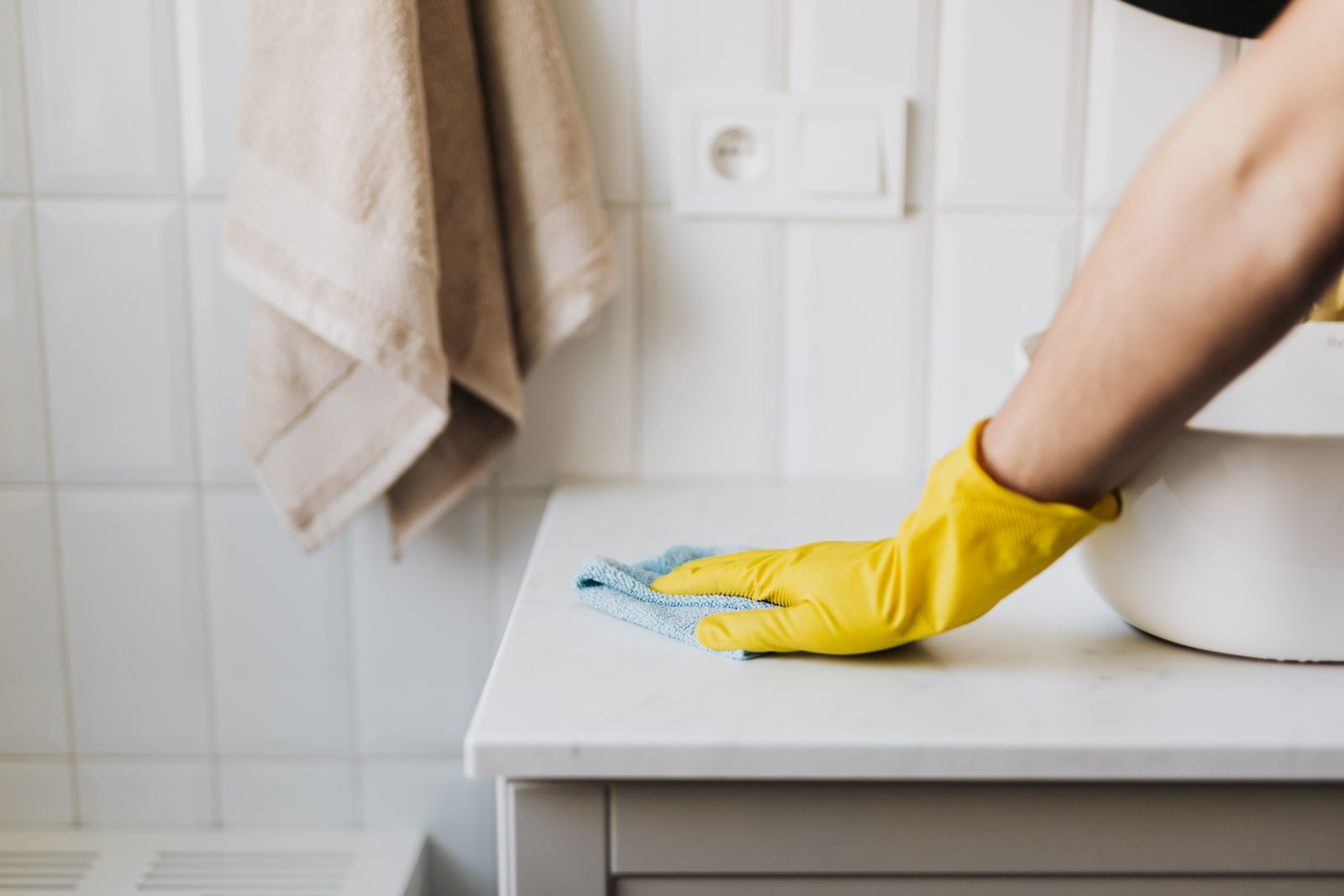
The two-cloth method is exactly what it sounds like: one cloth applies and lifts, a second cloth dries and finishes. It is the least glamorous technique in professional cleaning and the one that most visibly changes results for people who have never used it. Streaks stop appearing on glass. Stainless steel stops looking smeared. Surfaces stop feeling faintly tacky an hour later.
The reason one cloth fails isn’t laziness or a lack of effort — it’s physics and capacity. A cloth is a container. It holds a finite amount of soil and a finite amount of liquid, and once either is full, the cloth stops being a collection device and becomes a distribution device. Everything below is the mechanism behind that, and how to actually run two cloths without generating a laundry pile you’ll come to resent.
What the two-cloth method actually is
There are two versions in common use and it’s worth knowing which one people mean.
Wet-and-dry. Cloth one carries the cleaning solution: it applies product, works the surface and lifts the loosened soil. Cloth two follows immediately behind, dry, and takes off the residual moisture and any product film left behind. This is the version that matters for glass, mirrors, stainless steel, chrome, sealed stone, gloss cabinetry and anything else where a residue shows.
Dirty-and-clean. Cloth one takes the first pass on genuinely soiled surfaces and is treated as expendable for that surface. Cloth two, still clean, does the finishing pass. This is the version that matters in kitchens and bathrooms, where the first pass is removing bulk soil and the second is what actually leaves the surface clean.
In practice a professional often runs both at once: a soiled first cloth, a clean damp cloth, and a dry finishing cloth, which is really the three-cloth version of the same idea. But the jump from one cloth to two is where nearly all of the improvement lives. Going from two to three is a refinement; going from one to two is a category change. Getting there affordably is mostly a purchasing question, which is why the trade buys microfibre by the case rather than by the pack — the method only works if having a fresh cloth is cheap enough that you never hesitate to grab one.
A cloth is a soil sink with a finite capacity
Understand what a microfibre cloth is doing and the failure of the single-cloth approach becomes obvious.
Microfibre is a synthetic filament — usually a polyester and polyamide blend — that has been split into a large number of much finer strands. That splitting is the entire point. It creates an enormous surface area and, more importantly, a dense network of tiny channels between the filaments. Dry, the cloth carries a static charge that attracts dust and holds it. Damp, it works by capillary action: liquid and suspended particles are wicked into those channels and trapped there rather than being pushed around on the surface.
Which means a cloth cleans by storing soil, not by destroying it. And storage has a limit. As those channels pack with grit, grease and lint, the cloth’s ability to take on more drops off. Past a certain load, the balance flips: the cloth is now depositing more than it collects, and you are painting dirt onto the next surface with a tool that still looks and feels fine in your hand.
This is why the classic single-cloth session gets worse as it goes. The first counter looks great. The last one has a faint grey film that appears after it dries. Nothing changed about your technique — the cloth simply filled up somewhere around the third surface and nobody told you.
A saturated cloth also stops drying. A cloth full of liquid can’t wick any more, so it leaves water sitting on the surface instead of removing it, and water left to evaporate deposits whatever was dissolved in it — dissolved soil, product, and any minerals in the water itself. That’s the origin of most “clean but streaky” outcomes.
How much capacity is there? Enough to be worth quantifying, and not enough to survive a room. Cleaning-grade microfibre is a split filament with a linear density of about 1 dtex or below — cleaning constructions are often finer than 0.1 dtex per filament, giving individual strands under ten microns across, roughly a hundredth the width of a human hair — usually built as an 80/20 or 70/30 blend where the polyester does the scrubbing and holds the static charge and the polyamide does the absorbing. That structure is why a good cloth takes on several times its own weight in water. It is also why it fills.
The decline has been measured rather than asserted. A 2011 study in the Journal of Hospital Infection comparing different microfibre cloths on hospital-relevant organisms reported reductions in the range of 0.92–2.62 log CFU/cm² on stainless steel and 2.21–3.44 on laminate — and, more usefully for anyone holding a cloth, found that the performance of all the cloths tested fell as they were used repeatedly across a succession of contaminated surfaces.
Which points at the real answer to “how do I know when it’s spent”: you don’t, and neither do professionals, which is exactly why the trade does not rely on judgement. A loaded cloth gives you no signal. It does not feel different, it does not look obviously worse, and the surface it just ruined only shows the problem once it dries and you have moved on. Every workable system in the professional literature replaces the judgement call with a count — a fixed number of folded faces, then a fixed rule about changing at a zone boundary. Counting is reliable under fatigue. Assessing is not.
The residue problem: why a clean cloth still leaves streaks
Even with a perfectly clean cloth, one-cloth cleaning leaves something behind: the product.
Cleaning sprays contain surfactants, and surfactants are designed to stay at the interface between water and soil. When the water evaporates, the surfactant doesn’t leave with it. It stays on the surface as a thin film. That film is why a wiped mirror dries with a haze, why “clean” stainless shows every fingerprint immediately afterwards, and why a worktop wiped with all-purpose spray can feel very slightly tacky when you run a hand across it later.
Worse, the film is mildly hygroscopic and slightly sticky — so it attracts and holds airborne dust far better than the bare surface would. A residue-filmed surface gets visibly dusty faster than one that was properly finished. People interpret this as their house being unusually dusty. It’s usually the cleaning method.
The dry second cloth solves this in a single pass. It removes the remaining moisture before evaporation can deposit anything, and it physically buffs off the surfactant film. On glass and polished metal the difference is immediate and total. Anyone who has ever fought a mirror with one cloth, re-wiping and re-wiping into an ever-worsening smear, has been trying to remove residue with the thing that’s applying it.
There is a second contributor to that film, and the German trade literature is much blunter about it than anything on a domestic bottle: overdosing. German building-cleaning guidance treats dosing as a discipline with a named failure mode — too much product leaves a layer of surfactants, care substances and dried-on particulate, and the documented consequences are streaking, dull patches, slower drying and increased slip risk on floors. The trade’s line is that at normal soil levels a low concentration is sufficient and a heavier dose cleans worse, not better.
That is the sentence worth sitting with, because it inverts the domestic instinct completely. More spray does not mean more clean. It means more residue for the second cloth to remove, and if there is no second cloth it means a surface that is measurably stickier than the one you started with — which is why the surfaces people complain about most are the ones they clean most often. A kitchen worktop wiped daily with a generous spray of all-purpose and no dry pass is being laminated, one thin coat at a time.
Two cloths and a lighter hand on the trigger are the same fix from opposite ends. If you must pick one, pick the dry cloth — it removes yesterday’s film as well as today’s.
Cross-contamination: what travels from one surface to the next
The second reason to split cloths has nothing to do with streaks. A cloth carries whatever it last touched.
This is intuitive with visible soil — nobody willingly wipes a worktop with the cloth that just did the bin lid — but the invisible version is the one that matters. Bathroom fixtures, and toilets in particular, hold a bioburden that transfers readily to a damp cloth and then to the next surface that cloth meets. A single cloth working around a bathroom, in the natural order of toilet, then taps, then the counter, then the door handle, is an extremely effective transfer mechanism. It’s not a hypothetical: this is precisely the risk that produced colour-coded cloth systems in hospitals and commercial kitchens.
There’s a related mechanism that catches people out even when they’re being careful. Some disinfectants — quaternary ammonium compounds in particular, which is most consumer antibacterial sprays — bind to fabric fibres. This is documented, not folklore. Bloss, Meyer and Kampf, publishing in the Journal of Hospital Infection in 2010, exposed working solutions of three surface disinfectants to four fabric types — pulp/polyester, viscose rayon, polyester, and a viscose/cellulose/polyester mix — and found that how much active ingredient survived depended on which fabric it met. Cellulose-based fabrics were the worst offenders, and the depletion reported in this line of work runs high: figures on the order of 62% of benzalkonium chloride adsorbed onto viscose within three hours of contact, with the adsorbed compound staying bound to the fabric even after the cloth was wrung out. So the fibre absorbs the active ingredient out of the solution, what reaches the surface is weaker than what came out of the bottle, and it gets weaker with each subsequent wipe. A cloth reused across a whole bathroom is delivering progressively less disinfectant to progressively more contaminated surfaces. Synthetic microfibre binds less than cotton, but “less” is not “none”, and it’s a good argument for a fresh cloth face on every fixture rather than one cloth doing the room.
The practical rule the trade uses: a cloth that touches a toilet does not touch anything else, ever, before it goes in the wash. Not the cistern lid, not the flush handle, not the floor around it.
The trade draws that boundary with a radius, not around an object — and the German Vier-Farben-System states it in centimetres. Red-coded cloths and equipment cover WCs and urinals plus the floor within roughly 50 cm of them; yellow covers everything else in the same room, meaning basins, taps, mirrors, showers, baths, tiling outside the red zone and dispensers. Green is kitchens and food hygiene, blue is general surfaces. Suppliers publishing that scheme tie it to RKI guidance in care settings and to HACCP where food is handled, which is to say it is not a marketing convention — it is a hygiene control with an external reference.
The 50 cm figure is the useful part, and almost nobody applies it at home. People treat a toilet as a thing they clean. The professional model treats it as a zone with a boundary, because the mechanism that contaminates the pan contaminates the floor and the wall beside it too, and a cloth that touches the skirting board 30 cm from the pan is, for practical purposes, a toilet cloth.
Where the boundary genuinely cannot be a colour it should be a bin. Anything that has touched a WC, a nappy bin, a pet accident or raw meat residue is finished for the session — not rinsed, not relegated to floors, finished. The healthcare version of this rule is written into DS 2451-10, the Danish standard for cleaning in the health sector, which requires a new cleaning textile for each new patient area. Not a new fold. A new textile.
Folding: eight clean faces from one cloth
Two cloths only works if you can actually find a clean part of each. Balling a cloth in your fist gives you one working surface that fouls in seconds and then contaminates every other part of the cloth it’s touching.
The trade fold is simple. Take the cloth, fold it in half, then in half again. You now have a flat quarter-sized pad — four faces on the front, four on the back, eight clean working faces in one cloth. You work face one until it stops performing, flip to face two, and keep going. When all eight are used, that cloth is finished.
Three things this buys you:
- A flat pad puts even pressure on the surface, so you actually make contact across the whole width you’re wiping instead of just where your fingertips press. Fewer passes for the same result.
- Clean and dirty stay separated. A folded cloth keeps used faces on the inside where they can’t touch anything.
- You stop deciding. “Is this bit clean?” becomes “have I flipped yet?”, which you can answer without thinking.
The corollary is that a single cloth genuinely does have eight uses in it, which makes the two-cloth method much less laundry-intensive than people expect. Two folded cloths carry sixteen clean working faces — plenty for a whole bathroom or kitchen.
German and Swiss trade instruction formalises this to the point of naming both versions. The 8-Seiten-Tuchfaltmethode is the fold described above — once in half, then again across — giving eight faces. The 16-Seiten-Tuchfaltmethode folds the longer edge in half twice in the same direction and then once across it, giving sixteen. The working rule taught with them is that once both outer faces of the folded pad are used, you turn the pad so the soiled faces meet each other and work back through the sequence, so a clean face is always presented outward and the dirty ones are always buried.
The same instruction carries a detail that consumer advice reverses: spray the cloth, not the surface. Applying product to the pad in short bursts keeps dose down, keeps overspray off adjacent finishes, and stops you laying a puddle of solution onto soil you are about to spread — the exception being deliberate dwell jobs, where you do want product sitting on scale or grease for several minutes before you touch it.
What folding does not do
Here is the part the trade literature is honest about and consumer articles never mention: a fresh face is not a fresh cloth. A study at Copenhagen University Hospital, published in the Journal of Hospital Infection in 2009, tested precisely this — and tested it on the 16-side method specifically, which Danish hospitals had adopted for its economic and ergonomic advantages before anyone had checked whether it was hygienically sound. Researchers contaminated a surface at 4 cfu/cm², wiped it with a pre-moistened microfibre cloth folded for 16-side use, and then cleaned fifteen sterile surfaces, each with a new, unused side of the same cloth. Bacteria were transferred to all fifteen.
Read that carefully, because it is easy to over-read. It does not mean folding is pointless — folding is a productivity technique and a good one, and it demonstrably extends how much area one cloth covers before it starts smearing. What it means is that folding solves the capacity problem and does not solve the contamination problem. Sixteen faces buy you sixteen goes at removing soil. They do not buy you sixteen independent cloths, because the cloth is one wet object with liquid moving between its layers.
Which is the whole case for the two-cloth method in one line. Flip faces to keep cleaning. Change cloths to stop carrying.
Wet cloth, dry cloth: which does what
The division of labour changes slightly by surface. Roughly:
- Glass and mirrors. Damp cloth to clean, dry cloth immediately behind while the surface is still wet. The timing matters — if you let it start evaporating you’re buffing a partially-dried film rather than removing liquid, and that’s where smears come from.
- Stainless steel. Damp cloth first, then dry cloth with the grain. Stainless shows everything, so the dry pass isn’t optional. Going across the grain leaves visible marks even when the surface is genuinely clean.
- Sealed worktops. Damp cloth to lift, dry cloth to remove residue and stop water sitting in seams or around the sink cut-out, where standing moisture does real long-term damage.
- Wood and sealed cabinetry. The dry pass is doing damage control as much as finishing. Wood dislikes standing water; the second cloth removes it before it can find a joint or an edge.
- Bathroom chrome. Damp then dry, and the dry pass is what removes the water that would otherwise evaporate into fresh limescale spots. Most “hard water spotting” is simply water that was left to dry itself.
- Painted walls and skirting. Barely damp cloth, dry cloth right behind. Water left on paintwork leaves tide lines as it dries and pulls dirt back to the edge of the wet patch.
The pattern across all of them: the dry cloth’s job is to stop evaporation from happening on the surface. Anything dissolved in that water — soil, product, minerals — is left behind when water evaporates. Remove the water mechanically and none of it gets deposited.
Colour coding, and why the trade standardised it
Once you’re using multiple cloths, you need to tell them apart at a glance while your hands are full and your attention is on the work. Written labels don’t survive laundry and don’t get read mid-job. Colour does both.
The convention that spread out of healthcare and commercial catering assigns a colour to a zone rather than to a task — one colour for toilets and urinals, one for other bathroom surfaces, one for kitchen and food areas, one for general and low-risk use. The specific colours vary between suppliers and countries, which matters less than picking a scheme and never deviating from it.
What makes it work is that it converts a memory problem into a visual one. “Is this cloth safe to use on the worktop?” requires recalling where that cloth has been, and recall fails when you’re moving quickly. “Is this cloth the kitchen colour?” requires only looking down. Systems that survive fatigue are the ones that don’t depend on remembering anything.
At home you don’t need a full commercial scheme. Two colours will carry most of the benefit: one colour that only ever touches bathrooms, and one colour for everywhere else. Add a third for glass if you do a lot of it, because glass cloths need to stay free of the product residue and grease that general cloths accumulate.
One correction to how this usually gets presented, though. Charts circulate online captioned as though they were law, and outside healthcare they are not. BICSc — the British Institute of Cleaning Science, the UK’s professional body for the trade — states directly that with the exception of the healthcare industry, no compulsory national or international colour-coding standard exists in the cleaning industry, and that what it publishes are recommended guidelines. In healthcare it is mandated, and the reason is instructive: the National Patient Safety Agency imposed a single scheme across NHS England and Wales in 2007 because as many as fifty different colour conventions were then in circulation across the UK care sector — largely the same four colours with different meanings bolted onto them.
Nor do the meanings survive a border. Yellow is the clinical and isolation colour in the UK convention and the washbasin colour in the German Vier-Farben-System. That is a genuine hazard for anyone working to both, and it is the whole justification for the advice everyone repeats without explaining: the colours are arbitrary, and the consistency is not. Which colour you choose for bathrooms is worth about ten seconds of thought. Never breaking it is worth a great deal more. The wider system this belongs to works on the same principle throughout.
Running two cloths at home without drowning in laundry
The objection people raise is always the same: this is going to double the washing. It doesn’t, for three reasons — the eight-face fold, the fact that the dry finishing cloth stays comparatively clean, and the fact that a cloth used correctly lasts a very long time.
A workable home setup:
- Two colours minimum. One that only enters bathrooms, one for everything else.
- Carry a small stack, not one cloth. Enough for the zone you’re about to do, so you never have to make a spent cloth stretch.
- Fold in half twice, always. Flip faces rather than rinsing mid-job. Rinsing in a sink re-wets the cloth and puts the soil back into circulation.
- Keep the dry finishing cloth genuinely dry. The moment it’s damp it’s no longer a finishing cloth — it’s a second wet cloth, and it will streak.
- Wash microfibre separately, hot, and never with fabric softener. Softener is the single most common way people destroy a good set of cloths without realising, and then conclude microfibre is overrated. Specifics below.
- Retire cloths on a schedule, not on a verdict. A spent cloth gives no warning, so don’t wait for one.
How long a cloth lasts, according to the people who make them
Professional microfibre suppliers publish replacement guidance, which is more than most domestic packs do. Nordisk Microfiber, a Danish manufacturer supplying professional and healthcare cleaning systems, recommends that 33% of the textile system be renewed every two years — a rolling third, rather than replacing everything at once when performance has already collapsed. That is a laundry-cycle-driven figure from commercial use, where cloths are washed after every shift; a domestic set washed a fraction as often will outlast it comfortably. The useful part is the shape of the advice, not the number: microfibre degrades gradually and invisibly, so the trade replaces on a schedule rather than on a verdict.
The failure mode you can detect by hand is loss of split. New cleaning microfibre catches very slightly on dry skin — that drag is the split filaments engaging. A cloth that has gone smooth, stiff or glazed has either had its splits closed by heat or had them coated by softener, and no wash recovers it. At that point it is a rag: it will still move water around, and it will not pick anything up.
The laundering specification, from the manufacturers
This is where published specs are far more precise than anything in consumer advice, and where they also disagree with each other in a way worth understanding. Nordisk Microfiber’s professional guidance is deliberately aggressive:
- Wash hot. Minimum 80 °C under normal circumstances, and the manufacturer states the fibres will not come clean below about 70 °C. The soil is inside the channels, and only heat plus detergency gets it out.
- Use about a third of the normal detergent dose, at pH below 10.5, on the reasoning that microfibre is largely self-cleaning at those temperatures and excess detergent simply becomes another deposit in the fibre.
- No fabric softener — the stated mechanism is that softener encases the fibres — and if softener has been used, the cloths must be rewashed without it.
- No chlorine or bleach beyond whatever the detergent already contains.
- Dry cool. Tumble dry at 60 °C for a maximum of 15 minutes, or 40 °C for a maximum of 30 minutes. Microfibre is polyester and polyamide, both thermoplastic; a long hot cycle softens and fuses the split ends, which is the same loss of function as softener by a different route.
Now the disagreement. Koch-Chemie, a German manufacturer whose microfibre is aimed at paint and coating work, publishes the opposite temperature advice — wash cold, maximum 30–40 °C. Both instructions are correct for their purpose. Hot washing is a hygiene requirement where the cloth handles bioburden; cold washing protects fibre geometry where the cloth’s job is to touch delicate finishes without marking them. If you keep separate glass and bathroom sets, that is a real reason to launder them differently rather than a fussy one.
Two things every published spec agrees on: wash microfibre separately from cotton and wool, because microfibre grips shed lint like a hook-and-loop fastener and arrives at the next job already carrying it; and use liquid detergent rather than powder, because undissolved powder is particulate that lodges in exactly the channels you are trying to clear.
Frequently asked questions
Can I just rinse one cloth instead of using two?
Rinsing helps but doesn’t replace the second cloth, for two reasons. It leaves the cloth saturated, so it can’t dry a surface, and rinsing in a sink returns some soil to the fabric rather than removing it. A rinsed cloth is a wet cloth with less dirt in it — you still have nothing dry to finish with.
Does the second cloth have to be microfibre?
For the drying pass it helps a great deal, because microfibre absorbs far more than its weight and leaves no lint. Cotton terry works but wets through quickly. Avoid anything that sheds — paper towel and cheap cotton both leave fibres on glass, which is the exact problem you were trying to solve.
Why does my glass still streak with two cloths?
Usually one of three things. The dry cloth isn’t actually dry. You’re using too much product, so there’s more residue than the second cloth can lift. Or you waited too long and the surface began evaporating before you got there — on glass the dry pass should follow the wet one almost immediately.
How many cloths should I own?
Enough that you never ration them mid-job, which is the point at which people start reusing a spent cloth. Think in terms of a stack per zone rather than a number for the house, and buy in bulk in a couple of colours rather than a small mixed pack.
Can I use the same cloth on a toilet if I wash it afterwards?
Wash it, yes — reuse it on other surfaces, no. Keep toilet cloths as a permanently separate colour that never re-enters the general pool. The cost of a dedicated set is trivial next to the cost of getting it wrong once, and a colour boundary is far more reliable than a rule you have to remember.
Where does this fit into a full clean?
It’s one component of a larger sequence — top to bottom, dry before wet, one pass per surface. The cloth discipline is what makes the single-pass rule achievable in the first place. The full sequence is in what professional cleaners do differently.